DDD Entities
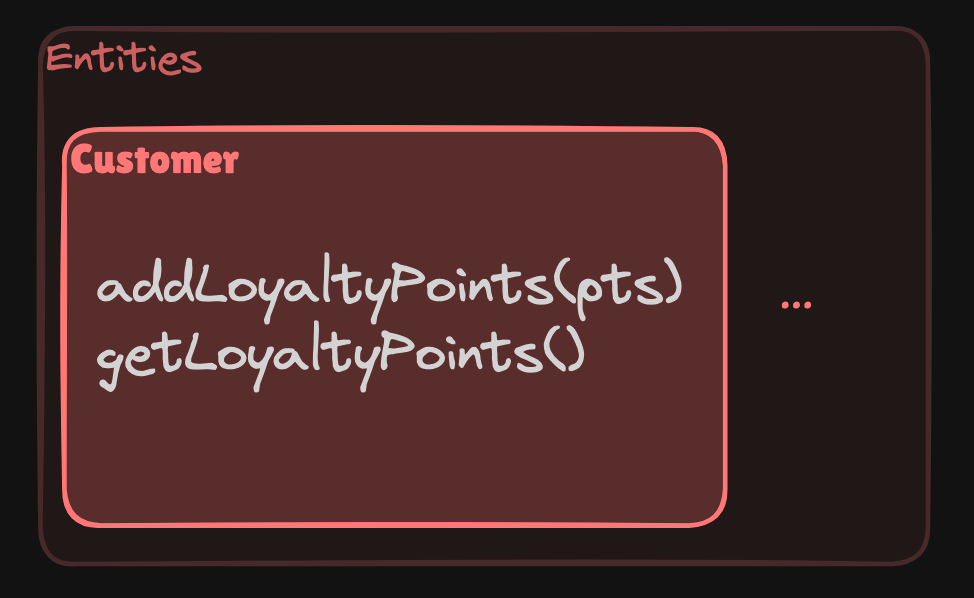
Entity
In Domain-Driven Design (DDD), an Entity is a fundamental building block of the domain model. Entities are objects that have a distinct identity that runs through time and different states. The identity distinguishes one instance of an entity from another, even if they have the same attribute values.
Entities are crucial because they represent something in the domain that changes over time but must be recognized as the same thing (e.g., a user, an order, or a product).
Key Characteristics
-
Identity: Every entity has a unique identifier (ID). This ID is constant through the life of the entity and is used to differentiate between instances.
-
Mutable State: Entities can change over time. Their attributes can evolve, but they must always be identifiable by their ID.
-
Behavior: Entities typically contain both state and behavior. They encapsulate business logic related to the state they hold.
Example
Let’s take an example from an e-commerce system where we have an Order entity. The Order entity has an ID, customer, and a list of items.
1. Defining an Entity
In TypeScript, we can define an Order entity that encapsulates the state and behavior of an order.
class OrderItem {
  constructor(public productId: string, public quantity: number, public price: number) {}
}

class Order {
  private items: OrderItem[] = [];
  private status: 'Pending' | 'Shipped' | 'Delivered' = 'Pending';

  constructor(public orderId: string, public customerId: string, public orderDate: Date) {}

  addItem(productId: string, quantity: number, price: number) {
    this.items.push(new OrderItem(productId, quantity, price));
  }

  getTotalAmount(): number {
    return this.items.reduce((total, item) => total + item.quantity * item.price, 0);
  }

  markAsShipped() {
    if (this.status !== 'Pending') {
      throw new Error("Order can't be shipped. Current status is " + this.status);
    }
    this.status = 'Shipped';
  }

  getStatus(): string {
    return this.status;
  }
}
Explanation
- Identity: The
Orderentity is identified by itsorderId. This is how we uniquely identify each order in the system. - State: The
Orderentity contains attributes such asitems,status, andorderDate, which can change over time. - Behavior: The
Orderentity contains methods likeaddItem(),getTotalAmount(), andmarkAsShipped(), which define its behavior.
2. Usage of the Entity
Here’s how we can use the Order entity:
const order = new Order('order123', 'customer456', new Date());

order.addItem('product789', 2, 50); // 2 items, price 50 each
order.addItem('product654', 1, 100); // 1 item, price 100

console.log(`Total amount: $${order.getTotalAmount()}`); // Total amount: $200

order.markAsShipped();
console.log(`Order status: ${order.getStatus()}`); // Order status: Shipped
3. Validation and Invariants in Entities
Entities often enforce business rules or invarians. For example, an order cannot be marked as shipped if it is already in a different status:
// marking an order as shipped multiple times will throw an error
try {
  order.markAsShipped(); // Error: Order can't be shipped. Current status is Shipped
} catch (error) {
  console.error(error.message);
}
4. Comparing Entities by Identity
Entities are typically compared by their identity, not by the values of their attributes. Two entities are considered equal if they have the same ID, even if their state is different.
const order1 = new Order('order123', 'customer456', new Date());
const order2 = new Order('order123', 'customer789', new Date());

// since both orders have the same ID, they are considered the same entity
console.log(order1.orderId === order2.orderId); // true
5. Entity and Behavior Encapsulation
Entities are not just data containers; they encapsulate business logic. For example, the Order entity controls how items are added and how the status changes. This ensures that business rules (such as "an order can only be marked as shipped if it is pending") are enforced within the entity itself.
In DDD, we avoid exposing internal data directly (such as the items array). Instead, we expose only what is necessary via methods, like addItem(), getTotalAmount(), and markAsShipped().
When to Use Entities in DDD
Entities are used when:
- The object represents something that has a distinct identity.
- The state of the object can change over time, but it must always be recognizable by its identity.
- The object contains behavior and encapsulates business rules.
Examples of entities in various domains:
- E-commerce:
Order,Customer,Product - Banking:
Account,Transaction - Logistics:
Shipment,Warehouse
Example of a Different Entity: Customer
Let’s define another entity, Customer, with its own identity and behavior:
class Customer {
  private loyaltyPoints = 0;

  constructor(public customerId: string, public name: string) {}

  addLoyaltyPoints(points: number) {
    if (points < 0) {
      throw new Error('Points cannot be negative');
    }
    this.loyaltyPoints += points;
  }

  getLoyaltyPoints(): number {
    return this.loyaltyPoints;
  }
}

// Example usage
const customer = new Customer('customer456', 'Alice');
customer.addLoyaltyPoints(100);
console.log(`Customer loyalty points: ${customer.getLoyaltyPoints()}`); // Customer loyalty points: 100
Conclusion
In Domain-Driven Design, entities represent core business objects that have a unique identity and encapsulate both state and behavior. They are not just data holders but include business logic to ensure the integrity of the system. By managing state and enforcing business rules within the entity, DDD helps create a more maintainable and robust system.
Next
Visit Aggregates to dive deeper into Domain Driven Design.
Check next:
READ
Latest readings
Readings are sites which will help you with detailed
information about given topic. Read latest ones from Learn.
06-03-2026
Build your own local voice assistant powered by Ollama.
06-03-2026
Generate YouTube thumbnails with FastAPI and Ollama.
05-09-2024
Compare Neo4j and Tigergraph databases, which is easier to work with, etc.